insect spy drone hoax

Is this a mosquito? It’s an insect spy drone for urban areas, already in production, funded by the US Government. It can be remotely controlled and is equipped with a camera and a microphone. It can land on you, and it may have the potential to take a DNA sample or leave RFID tracking nanotechnology on your skin. It can fly through an open window, or it can attach to your clothing until you take it in your home. Mixture of hoax and facts. The story comes with a picture claiming to show a Mosquito spy drone that can take photographs and DNA samples of people, and that it is funded by the U.S government for tracking people. It is a fact that there are reports suggesting that research is going on to develop the MAV's, i.e. Micro Air Vehicles in the form of tiny flying objects like a mosquito. The purpose of these MAVs is to be useful in scientific and military applications. The micro flying robot can have cameras, microphones and other sensors that can take pictures, videos and other useful scientific and biological information from people and places where humans (or the military) cannot reach.

This way the tiny flying robots can also be used as spies and weapons against enemies. In 2007, at the International Conference on Intelligent Robots and Systems (IROS), the latest developments in unmanned aerial vehicles (UAVs) were showcased. Scientists talked about the design of micro UAVs of insect-size that actually flap their tiny little wings, and convey important communication information in a given mission. Not just from U.S, there were in total 20 UAV-related papers at the conference, from four continents and eight countries, including Portugal, Germany, France, Switzerland, Japan, Australia, Mexico, and Brazil. In 2008, the U.S. military engineers were trying to design flying robots disguised as insects which can fly and spy on enemies to conduct dangerous missions without risking human lives. Refer to an animated picture in the image section below. Greg Parker, who helps lead this research at Wright-Patterson Air Force Base in Dayton talks about this saying: "The way we envision it is, there would be a bunch of these sent out in a swarm.
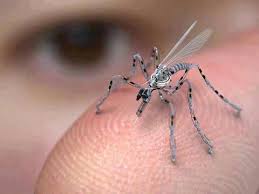
If we know there's a possibility of bad guys in a certain building, how do we find out? We think this would fill that void." Parker and his team planned to start and develop such a bird-sized robot as soon as 2015, followed by the insect-sized models by 2030. The picture shown in the story is not a real robot mosquito drone, but simply one such proposed 'prototype' that may become reality in future, and perhaps they will also be able to take photographs and DNA samples of people. But as of now, these are only speculations, and not facts in practical. A quote from RT America confirms the same: As early as in 2007 the US government was accused of secretly developing robotic insect spies when anti-war protesters in the US saw some flying objects similar to dragonflies or little helicopters hovering above them. No government agency has admitted to developing insect-size spy drones though some official and private organizations have admitted that they were trying. Watch the video, it explains the same story.

Unraveling a Butterfly's Aerial Antics Could Help Builders of Bug-Size Flying RobotsThe Coolest Flying Robot Projects At IROS ConferenceU.S. hopes to develop bug-sized, flying spiesUS military surveillance future: Drones now come in swarms?Forget the roachbots and the swarm of MIT humanoid robots dancing in sync, as well as "disposable" quarter-sized kilobots which are "cheap enough to swarm in the thousands," and think instead of DARPA-like tiny insect cyborg drones that are "designed to go places that soldiers cannot" to work as spies or as swarm weapons.
parrot ar drone orlandoIs this a mosquito micro air vehicle (MAV)?
macdev drone dx board updateAlan Lovejoy wrote, "Such a device could be controlled from a great distance and is equipped with a camera, microphone.
macdev drone dx board update
It could land on you and then use its needle to take a DNA sample with the pain of a mosquito bite. Or it could inject a micro RFID tracking device under your skin." While DNA-sucking, RFID-chip-injecting mosquito drones are currently a bunch of bunk, a Bing image search shows a multitude of MAVs that aren't simply CGI mockups. This little MAV had a 3 centimeter wingspan and that was back in 2007. When the U.S. government was accused of making insect spy drones in 2007, Tom Ehrhard, a retired Air Force colonel and expert on unmanned aerial craft, told the Telegraph, "America can be pretty sneaky."
best drone for real estate photographyThe article also mentioned a dragonfly drone the CIA had developed in the 1970s.
phantom 2 vision drone priceWhile reading people's comments concerning spy drones flying overhead, there have been many comments about "skeet shooting" drones down from the sky.
black ops 2 maxis drone parts
That would most likely be destroying government property and make a person a "terrorist." Besides, would you really see a tiny part bot, part bug "cyborg insect" drone from a distance if it was spying on you?In 2008, the U.S. Air Force showed off bug-sized spies as "tiny as bumblebees" that would not be detected when flying into buildings to "photograph, record, and even attack insurgents and terrorists." Many flying insect drones were developed into prototypes that year, but look again at the fly drone that could fit on the tip of your finger. Gizmo Insider suggested, "We've heard of a fly swatter, but what about a marksman trying to shoot down every fly he sees within a 100 yard radius. The future of warfare and intelligence collection just got a whole lot more sophisticated." That was five years ago, so what insect spy drones exist now that the public doesn't know about?The MAV Ornithopter on the left, so-called "lethal mini drones," were being developed outside of Dayton, Ohio, and were set to roll-out by 2015.Lockheed Martin's Intelligent Robotics Laboratories unveiled "maple-seed-like" drones called Samarai that also mimic nature.

U.S. troops could throw them like a boomrang to see real-time images of what's around the next corner, the Navy Times reported. It could also be "useful for the military and police" to look inside buildings. But nano-biomimicry MAV design has long been studied by DARPA. DARPA's 2008 symposium discussed "bugs, bots, borgs and bio-weapons." The Pentagon's "cyborg moth" is now defunct tech and bat drone bots are also old surveillance news. Researchers have developed bio-inspired drones with bug eyes, bat ears, bird wings, and even honeybee-like hairs to sense biological, chemical and nuclear weapons.The future of hard-to-detect drone surveillance will mimic nature. The dragonfly "insect spy" drone is old, but bug-sized microdrones with flapping wings are still considered the future. The U.S. is not alone in miniaturizing drones that imitate nature; France has flapping wing bio-inspired microdrones [PDF] and the Netherlands BioMAV (Biologically Inspired A.I. for Micro Aerial Vehicles) developed a Parrot AR Drone last year;

it's now available in the USA as a "flying video game" toy. DARPA's Hummingbird Nano Air Vehicle (NAV) was named by Time Magazine as one of the best 50 inventions of 2011. John Hopkins University said in February 2012 that "butterfly research will aid the development of flying bug-size robots" and showed off this "insect-inspired flapping-wing MAV under development at Harvard University." That looks a great deal like the "fly drone" yet again, only this time compared to a penny. Are they commonly used and we just don't know it? The Air Force Office of Scientific Research and the National Science Foundation funded the insect flight dynamics research, so John Hopkins reseachers have turned to studying even smaller MAV bugs like fruit flies.The University of Pennsylvania GRASP Lab showed off drones that swarm, a network of 20 nano quadrotors flying in synchronized formations. Engadget called them "four-bladed aerial ninjas," but the SWARMS goal is to combine swarm technology with bio-inspired drones to operate "with little or no direct human supervision" in "dynamic, resource-constrained, adversarial environments."